How Much Does Catch-Up Bookkeeping Cost in Canada?
Looking for US catch-up bookkeeping costs? Read the US version of this guide.
If you're months—or an entire year—behind on your bookkeeping, one of your first questions is probably:
How much is this going to cost to fix?
Unfortunately, there isn't one standard price for catch-up bookkeeping in Canada.
A straightforward self-employed consultant with one bank account and a few hundred transactions may have a relatively inexpensive cleanup. A business with several accounts, GST/HST, payroll, mixed personal spending and thousands of transactions can cost considerably more.
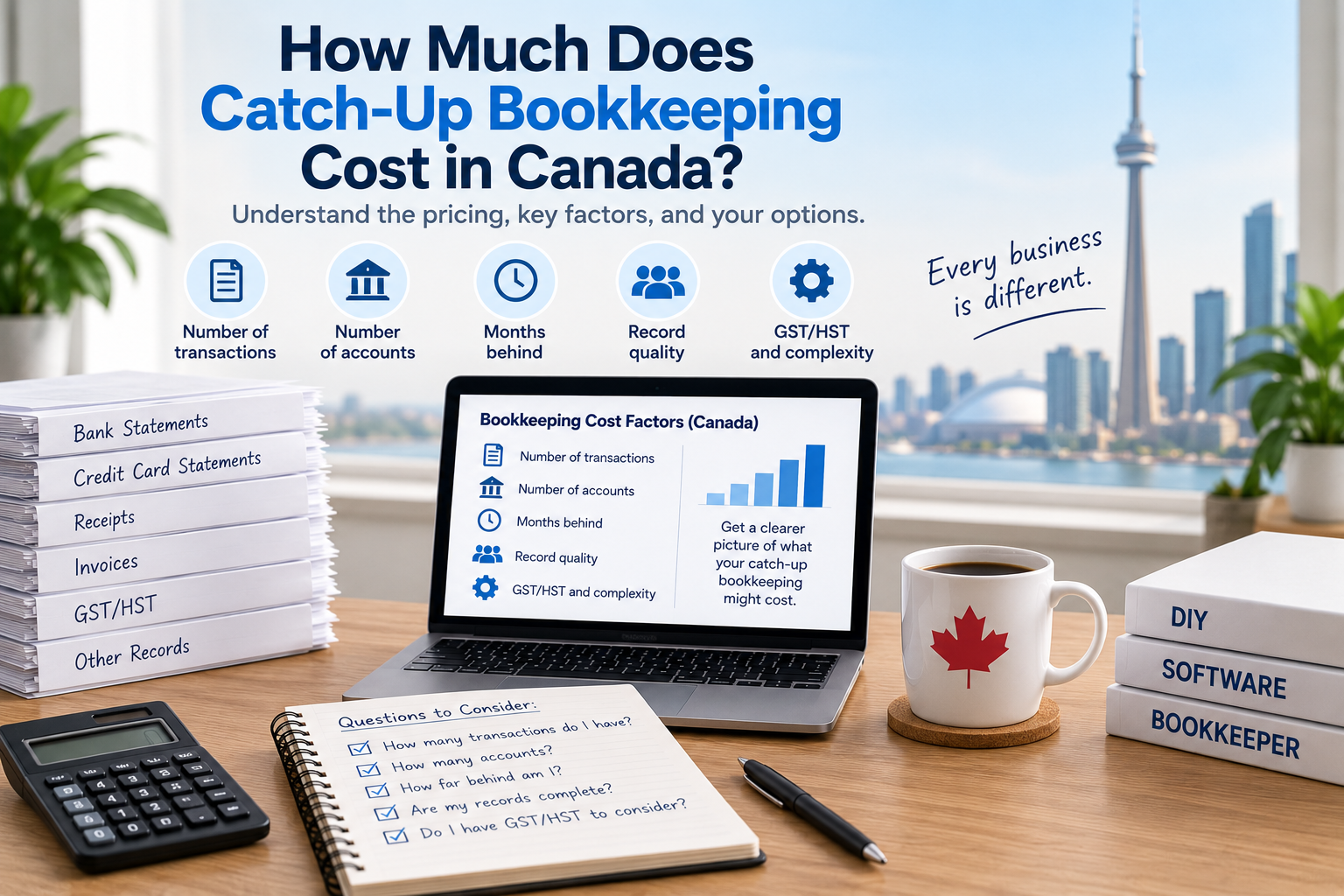
For a Canadian sole proprietor, the biggest factors affecting catch-up bookkeeping cost are usually:
- how many transactions you have
- how many bank and credit-card accounts need to be reviewed
- how many months or years you're behind
- whether personal and business spending is mixed
- how complete your records are
- whether GST/HST needs to be considered
- whether the business has payroll, inventory, loans or other complexities
- whether you're starting from bank statements or cleaning up an existing bookkeeping system
Here's how to think about what catch-up bookkeeping might cost—and when you may be able to do some or all of the work yourself.
What does catch-up bookkeeping cost in Canada?
There isn't an official Canadian rate for catch-up bookkeeping.
Bookkeepers may charge:
- an hourly rate
- a fixed project fee
- a fee per month of bookkeeping being caught up
- a price based partly on transaction volume
- a combination of these approaches
Published Canadian bookkeeping prices vary significantly. Current Canadian providers commonly quote ordinary bookkeeping rates in roughly the C$30 to C$90 per hour range, although experience, location and the work being performed can push rates outside that range.
Catch-up work can be considerably more expensive than simply multiplying a normal monthly bookkeeping fee by twelve.
That's because the bookkeeper may first need to determine what happened, locate missing information, correct previous errors and reconstruct transactions that should ideally have been recorded throughout the year.
Published Canadian catch-up-bookkeeping estimates illustrate just how wide the range can be. One Canadian provider estimates a relatively straightforward full-year rebuild at approximately C$1,000 to C$5,000, while other providers quote substantially higher amounts for complicated or severely backlogged files.
Those aren't regulated rates or guarantees of what you will pay.
The more useful question is:
What is actually driving the cost of my bookkeeping?
1. Transaction volume can matter more than months behind
Being twelve months behind sounds much worse than being three months behind.
But transaction volume can matter just as much.
Consider two businesses.
Business A
A consultant has:
- one bank account
- one credit card
- 30 transactions per month
- approximately 360 transactions for the year
Business B
An online business has:
- three bank accounts
- two credit cards
- 500 transactions per month
- approximately 6,000 transactions for the year
Both are one year behind.
They are clearly not the same bookkeeping project.
This is why many bookkeepers want to know your approximate monthly transaction volume before providing a quote.
2. The number of accounts affects the price
Each additional account creates more work.
A bookkeeper may need to process and reconcile:
- chequing accounts
- savings accounts
- credit cards
- payment processors
- lines of credit
- other financial accounts
Transfers between accounts also have to be identified correctly.
If you transfer $2,000 from your chequing account to your savings account, you haven't earned another $2,000 of revenue.
When multiple accounts are involved, identifying these transfers becomes part of reconstructing the books.
3. Mixed business and personal spending increases the work
This is common with sole proprietors.
Perhaps you used your business account to buy groceries.
You also used your personal credit card to buy business software.
Now somebody needs to determine which transactions belong to the business.
The more mixed the accounts are, the more review is required.
A bookkeeper may also need you to answer questions about transactions they can't identify.
That adds both time and cost.
4. Missing records can make catch-up bookkeeping expensive
Good records make catch-up bookkeeping easier.
Missing records do the opposite.
The Canada Revenue Agency is direct about the obligation: you are required by law to keep records of all your transactions to be able to support your income and expense claims. CRA's guidance specifically identifies bank statements, deposit slips, sales invoices, receipts and other supporting documents as part of those records, and generally requires them to be kept for six years from the end of the last tax year they relate to.
If your records are incomplete, you may need to:
- download old statements
- request invoices from suppliers
- search email for receipts
- reconstruct payment information
- investigate unknown transactions
- determine what deposits represented
That investigation takes time.
And if you're paying someone by the hour, time becomes money.
5. GST/HST can add another layer
For a Canadian business registered for GST/HST, catch-up bookkeeping may involve more than determining income and expenses for the T2125.
The records may also need to support:
- GST/HST collected
- input tax credits
- GST/HST returns
- previous filings
- adjustments
CRA sets out registrants' record obligations in Guide RC4022, General Information for GST/HST Registrants.
If GST/HST filings are also behind or incorrect, the scope may become significantly larger than simply organizing expenses for your personal tax return.
6. Payroll, inventory and accounts receivable can change the project entirely
A straightforward sole proprietor might primarily need bank transactions organized.
Another sole proprietor may have:
- employees
- payroll remittances
- inventory
- customers who owe money
- unpaid supplier bills
- loans
- equipment financing
- foreign currencies
At that point, you're no longer simply categorizing a pile of transactions.
You're reconstructing accounting records.
That's where professional bookkeeping becomes much more valuable.
Can I save money by doing catch-up bookkeeping myself?
Potentially.
For a straightforward sole proprietor, DIY catch-up bookkeeping may be completely reasonable.
You can gather your statements, enter the transactions into a spreadsheet, identify business income, separate personal spending and categorize expenses. Our step-by-step guide to catching up on a year of bookkeeping walks through the whole process.
We've created a free Catch-Up Bookkeeping Excel Template for exactly this situation.
Download the free Catch-Up Bookkeeping Excel Template (XLSX)
Your monetary cost may be close to zero.
The trade-off is your time.
If you have 700 transactions and spend even one minute entering, reviewing and categorizing each one, that's nearly 12 hours before considering missing receipts, unknown transactions and final review.
For a small number of transactions, that may be perfectly reasonable.
For a large number, you may decide your time has a higher value.
Do I need QuickBooks or other bookkeeping software?
Not necessarily.
Full bookkeeping software can make sense if you want to maintain ongoing books throughout the year.
But if you're a straightforward sole proprietor and your immediate problem is:
"I need to organize last year's bank and credit-card activity for my tax return,"
setting up a complete accounting system retroactively may be more than you need.
The CRA does not require a sole proprietor to use a particular commercial bookkeeping product. It requires adequate records supporting your business transactions. CRA states plainly that it does not issue record books nor suggest any type of book or set of books, that many bookkeeping systems are available, and that computerized records are acceptable provided they are clear and easy to read.
The appropriate system depends on the complexity of your business.
When is hiring a bookkeeper worth the cost?
A bookkeeper may be well worth the money when:
- you have thousands of transactions
- several accounts need reconciling
- you're more than one year behind
- records are missing
- business and personal spending are heavily mixed
- GST/HST filings are involved
- you have payroll
- you carry inventory
- you have accounts receivable or payable
- there are loans or complicated transactions
- you simply don't want to spend your own time doing it
Professional bookkeeping is particularly valuable when the problem isn't merely volume, but accounting complexity.
What about a straightforward sole proprietor with lots of transactions?
This is where there's a middle ground.
Suppose your business isn't particularly complicated.
You don't have inventory, employees or complicated accounting.
You simply have a year of bank and credit-card statements containing hundreds of transactions.
You could enter everything manually into Excel.
You could pay a bookkeeper to do it.
Or you could automate much of the initial organization.
That's the problem Heightly was built to solve.
Heightly lets Canadian sole proprietors upload their bank and credit-card statements. It extracts transactions, organizes them into possible categories, flags items requiring review and aligns the information toward T2125 categories.
You then review the results and can download an organized PDF and Excel report.
Heightly doesn't determine whether an expense is deductible, prepare your tax return or replace professional advice.
It tackles the mechanical part of the problem: turning statements into organized transactions.
For a straightforward sole proprietor, that can be considerably different from paying someone to reconstruct a complete set of books.
How can I reduce the cost before giving everything to a bookkeeper?
If you're going to hire someone, organization can help.
Before sending the file over:
- Download all bank and credit-card statements.
- Make sure every month is present.
- Identify which accounts were used for the business.
- Gather sales records.
- Locate major receipts and invoices.
- Identify obvious personal transactions where possible.
- Gather GST/HST information if applicable.
- Make a list of major equipment purchases.
- Tell the bookkeeper about loans or unusual transactions.
- Respond promptly when they send questions.
Don't spend 20 hours trying to save one hour of professional bookkeeping.
But giving someone complete records is very different from handing them an unsorted pile and asking them to figure out what's missing.
We've written a longer guide on preparing bank statements for your accountant if you want the detail.
Is catch-up bookkeeping tax deductible in Canada?
Bookkeeping and accounting fees incurred for business purposes may generally be deductible business expenses, subject to the normal tax rules and the nature of the particular expenditure.
For a sole proprietor, professional fees are among the expense categories addressed in CRA's T2125 guidance.
Your specific circumstances can affect the treatment, so this isn't a reason to hire unnecessary services simply for a deduction.
A tax deduction reduces taxable income. It doesn't make the service free.
How much should you spend on catch-up bookkeeping?
Start by determining what kind of problem you actually have.
If you have:
A few hundred straightforward transactions
→ DIY Excel may be completely reasonable.
Many straightforward bank and credit-card transactions
→ automation may be worth considering.
A business that needs ongoing books
→ bookkeeping software may make sense.
Complicated or incomplete accounting records
→ a professional bookkeeper may be worth the cost.
If you're not sure which category you fall into, read our comparison: Catch-Up Bookkeeping for Sole Proprietors: DIY, Software or a Bookkeeper?
The cheapest option isn't automatically the best one.
But neither is the most sophisticated.
The objective is to spend an amount that's appropriate for the actual bookkeeping problem you're trying to solve.
This article provides general information only and is not accounting, tax or legal advice. Bookkeeping prices vary significantly by provider, location, transaction volume, record quality and complexity. Any pricing ranges discussed are illustrative market examples rather than prescribed or guaranteed rates. Tax treatment depends on your circumstances. Consult a qualified professional regarding your specific situation.
This article is for general informational purposes only and is not tax, legal, or accounting advice. Rules vary by province, state, and business type, and change often — confirm details with a qualified tax professional (or the CRA / IRS directly) before filing. Heightly is software, not a tax filing service.
Turn your bank statements into a Tax Prep Report
Try Heightly free — turn your bank statements into a tax prep report in minutes.
Get started free →