T2125 Bookkeeping: Turn Bank Statements Into a Tax-Prep Report
Your bookkeeping isn't done. Your taxes still need to be.
If you're a sole proprietor in Canada, you report your business or professional income and expenses on Form T2125, Statement of Business or Professional Activities, as part of your personal T1 return.
Maybe you're comfortable preparing your own return using tax software. You know your business and you're happy answering the tax questions.
There's just one problem.
You have a year of bank statements, perhaps a credit card you use for business, and no completed bookkeeping.
Before you can prepare your T2125, you need to turn all of those transactions into organized business records.
You could do it manually. You could hire a bookkeeper to catch up the year. Or, if you're a relatively straightforward sole proprietor, you can use software designed to organize your records for tax preparation.
What information does a T2125 need?
The T2125 doesn't ask for your bank statements. It asks for totals against specific numbered lines — the GIFI codes — and that's the gap between a pile of transactions and a finished return.
Part 4 of the form lists them: Advertising on 8521, Meals and entertainment on 8523, Insurance on 8690, Interest and bank charges on 8710, Business taxes, licences and memberships on 8760, Office expenses on 8810, Professional fees on 8860, Rent on 8910, Travel on 9200, Utilities on 9220, Motor vehicle expenses on 9281, and anything that doesn't fit a named line under Other expenses on 9270.
There can also be capital assets, GST/HST considerations and business-use-of-home expenses depending on your situation.
Your tax software can help you complete the T2125. But first, someone needs to determine the numbers you're going to enter. That's the bookkeeping problem.
Can you do T2125 bookkeeping from your bank statements?
For a straightforward sole proprietor, bank and credit card statements contain a great deal of what you need.
Imagine you're a consultant with one bank account and one credit card used mainly for business. Your statements may hold hundreds of transactions that need to be reviewed, separated between business and personal activity, and organized into useful tax categories.
The information is there. The problem is turning it into something useful.
And statements don't contain the whole picture. Most Canadian sole proprietors report on the accrual basis, which means income and expenses aren't recorded simply when money moves through your bank account. You may also have:
- Business expenses paid personally
- Amounts owing to or from customers at year-end
- Vehicle expenses requiring a business-use percentage
- Business-use-of-home expenses
- Equipment purchases that are capital, not expenses
Bank statements are an excellent starting point. They aren't automatically a completed T2125.
Option 1: Organize the bookkeeping yourself
For a simple business, you can absolutely do your own. Download your transactions, build a spreadsheet, and work through the year one transaction at a time: identify what relates to the business, assign categories, investigate anything you don't recognize, then total everything.
For a business with few transactions, this may be all you need. The downside is time — working through hundreds or thousands of transactions manually gets tedious fast.
Option 2: Hire a bookkeeper to catch up the year
A professional bookkeeper can review the transactions, ask questions, investigate discrepancies and help ensure the records are complete. If you'd rather hand this to someone else, it's an excellent option.
The challenge with once-a-year bookkeeping is timing. A lot of sole proprietors discover they need help at roughly the same moment: tax season. Depending on where you are and who's available locally or virtually, finding someone willing to take on annual catch-up work isn't always easy.
Option 3: Software built for annual tax-prep bookkeeping
There's a third option for straightforward sole proprietors who don't need full monthly bookkeeping. That's the gap Heightly was built for.
It isn't an ongoing accounting system. It doesn't replace your accountant or tax preparer. And it doesn't file your T1 or T2125.
It solves a narrower problem: the year is over, your bookkeeping isn't done, and you need your records organized for your T2125.
What an organized T2125 report looks like
Here's the end product — activity organized into a tax-prep report aligned with T2125 categories, with the GIFI line already assigned and GST/HST separated out:
Revenue
| Category | T2125 / GIFI | Total deposits (incl. taxes) | GST/HST | Net sales (T2125) |
|---|---|---|---|---|
| Revenue | 8000 | $120,616.06 | $5,743.63 | $114,872.43 |
| Off-bank revenue (customer-provided) | — | $750.00 | $35.71 | $714.29 |
| Less: customer refunds and returns | 8000 | ($472.50) | ($22.50) | ($450.00) |
| Net revenue | $120,893.56 | $5,756.84 | $115,136.72 |
Expenses
| Category | T2125 / GIFI | Gross | GST/HST | Net (T2125) |
|---|---|---|---|---|
| Advertising | 8521 | $6,745.12 | $321.20 | $6,423.92 |
| Meals & entertainment | 8523 | $853.78 | $20.36 | $833.42 |
| Insurance (business) | 8690 | $3,188.04 | — | $3,188.04 |
| Interest and bank charges | 8710 | $239.40 | — | $239.40 |
| Business taxes, licences, memberships | 8760 | $14,183.30 | — | $14,183.30 |
| Office expenses (general) | 8810 | $4,762.83 | $212.53 | $4,550.30 |
| Office stationery and supplies | 8811 | $463.09 | $20.67 | $442.42 |
| Professional fees | 8860 | $2,677.50 | $127.50 | $2,550.00 |
| Maintenance and repairs | 8960 | $146.12 | $6.52 | $139.60 |
| Travel | 9200 | $1,262.77 | $60.13 | $1,202.64 |
| Utilities | 9220 | $2,018.76 | $96.12 | $1,922.64 |
| Other expenses | 9270 | $34.71 | $1.55 | $33.16 |
| Total expenses | $36,575.42 | $866.58 | $35,708.84 |
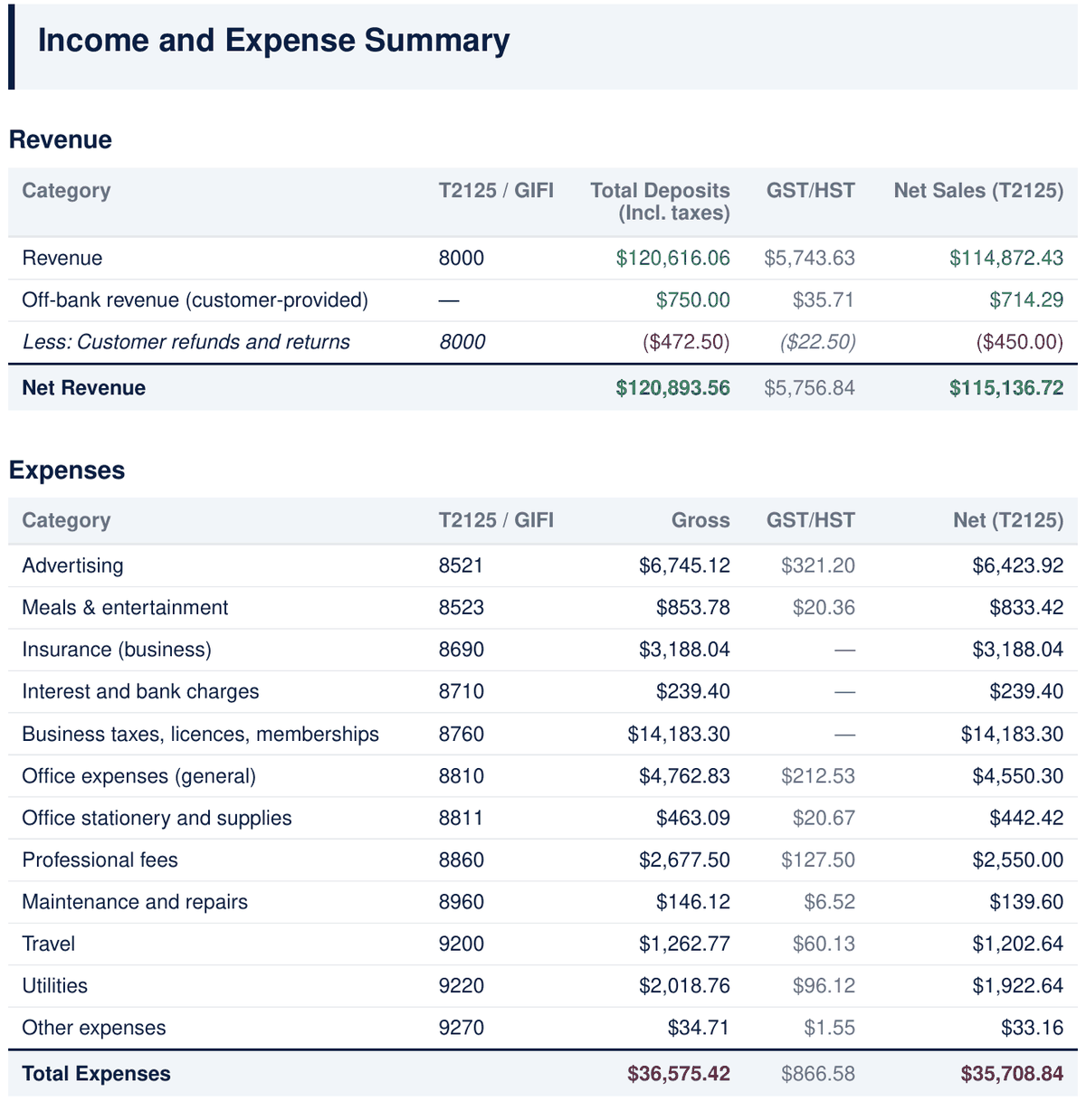
Note the third column. For a GST/HST registrant the embedded tax is separated out, so the net figures are the ones that belong on the T2125 — and the GST/HST portion is tracked separately rather than inflating your expenses. Motor vehicle expenses are reported separately again, because they need a business-use percentage before anything reaches line 9281.
How it works
1. Upload your statements. Supported PDF or CSV bank and credit card statements. The transaction information is extracted and organized so you don't have to combine a year of statements by hand.
2. Review your transactions. Categories are suggested and anything uncertain is flagged for you. That review matters, because descriptions don't tell the whole story. A $500 purchase from Best Buy might be computer equipment for your business. Or it might be a television for your living room. Software can't know that from the merchant name. Heightly does the repetitive organization; you provide the context.
3. Download your reports. A PDF summary and a detailed Excel workbook. Use them to prepare your own return, or hand them to your tax preparer.
Preview your T2125 tax-prep report → — one statement, no payment details.
Why not just use monthly accounting software?
QuickBooks and Xero are extremely useful. If you need to send invoices, track receivables, manage bills, maintain ongoing GST/HST records, produce financial statements or understand how your business is performing through the year, proper books maintained all year is the better answer. Same if you have employees, inventory or more complex accounting needs.
But not every sole proprietor needs all that. If you're a photographer, consultant, therapist, contractor, coach, designer or freelancer with a straightforward business, you may not need monthly financial statements at all — you need your records organized so you can file. Paying for accounting software every month can be more than the job requires.
Your bank statement isn't your receipt
Whether you use Heightly, a spreadsheet or a bookkeeper, organizing transactions doesn't replace your supporting documents.
A bank statement may prove you paid $325 to a particular retailer. It doesn't establish what you bought or why it was a business expense. You still need to keep invoices, receipts and other records supporting the amounts on your return — six years after the tax year, under the Income Tax Act.
What about GST/HST?
GST/HST adds a layer. Whether you need to register, how much to collect, and which input tax credits you can claim all depend on your circumstances — and depending on your province you may have PST, RST or QST obligations as well.
Heightly organizes GST/HST information as part of the Canadian workflow, but it doesn't replace your responsibility to determine your own obligations. If you have complicated GST/HST reporting or multiple sales-tax obligations, fuller bookkeeping is likely appropriate.
Who it's for
Straightforward sole proprietors who need their records organized for tax preparation — freelancers, consultants, photographers, therapists, independent contractors, coaches, designers, creators and other service-based sole proprietors. It suits businesses where most activity flows through a manageable number of accounts and the owner is comfortable reviewing their own transactions.
It may not be right if you have significant inventory, complicated receivables or payables, employees, complex sales-tax requirements, or other needs that call for a complete bookkeeping system. It also isn't available to Quebec residents, since it doesn't support QST or French-language filing.
Frequently asked questions
Does Heightly prepare my T2125?
No. It organizes your records into a tax-prep report aligned with T2125 categories. It doesn't prepare or file the T2125 or your T1. Use the reports when preparing your own return, or give them to your tax preparer.
Does Heightly replace an accountant or bookkeeper?
No. Heightly is software and doesn't provide accounting or tax advice. An accountant or bookkeeper can consider information outside your statements, ask questions, investigate discrepancies and apply judgment to your circumstances. Heightly is for straightforward sole proprietors comfortable reviewing their own records who want the repetitive organization automated.
Can I just use ChatGPT for my bookkeeping?
General-purpose AI can help with individual questions, but a full year of transactions runs into problems a chat window doesn't solve — volume limits, arithmetic that isn't computed, and the same transaction getting different categories on different runs. We've written about this honestly in Can ChatGPT or Gemini do my taxes from bank statements?
Is Heightly a monthly subscription?
No. You buy the report for the tax year you need rather than subscribing to another monthly platform. There's a free preview so you can see how it handles your records before deciding.
Your bookkeeping isn't done. Your taxes still need to be.
Ideally every business owner arrives at tax time with perfectly organized books. Real life doesn't always work that way.
If you're a straightforward Canadian sole proprietor and tax time has arrived with your records still sitting in bank and credit card statements, you have options: build the bookkeeping yourself, hire a bookkeeper to catch up the year, or use software designed to organize those records for tax preparation.
Start your free Heightly preview →
Filing in the United States? Read our guide to turning your bank statements into a Schedule C tax-prep report.
Important information
Heightly is a software product and does not provide accounting, tax or legal advice. It does not prepare or file income tax returns. It helps organize information from the records you provide; you remain responsible for reviewing those records for accuracy and completeness and for determining the appropriate tax treatment of your transactions. Canadian tax and accounting requirements depend on your particular facts and circumstances — consult a qualified tax professional, or check against CRA Guide T4002, where appropriate.
Note for Quebec residents: The Service is not available to Quebec residents. See heightly.ai/app/quebec-not-supported for details.
This article is for general informational purposes only and is not tax, legal, or accounting advice. Rules vary by province, state, and business type, and change often — confirm details with a qualified tax professional (or the CRA / IRS directly) before filing. Heightly is software, not a tax filing service.
Turn your bank statements into a Tax Prep Report
Try Heightly free — turn your bank statements into a tax prep report in minutes.
Get started free →